
The E DE Community of 54 Ethnic groups in Vietnam
Hits: 1135
The E DE have nearly 306,333 inhabitants concentrating in Dak Lak2, western parts of Khanh Hoa3 and Phu Yen Provinces4. The E DE community comprises of different local subgroups: Kpa, Adham, Bib, Ktul, etc. Previously, they were also called RA-DE and DE. The E DE language belongs to the Malayo-Polynesian5 group.
The E DE mainly practise cultivation on milpas. The Bih adopt a rudimentary wet-rice cultivation, using buffaloes to trample the fields. Besides cultivation, the E DE also practise animal husbandry, hunting gathering, fishing basketry and weaving. At present coffee is popularly planted in the E-DE community.
Dark indigo is the traditional color of E DE attire which Is also decorated with colorful motifs. E DE women wear skirts and lungis while men use loincloths and shirts. They like to wear bronze silver Jewelry or beads. According to ancient principles, the E DE had to file six upper front teeth. Now, this practise is now abandoned by young E DE people.
In E DE society, matriarchy is prevailed. Women are the masters of their families. Children take the family name of their mother. The right of inheritance Is reserved for daughters only. After marriage, a man come to live at his wife’s house. If the wife dies and nobody among the wife’s relatives replaces her position, the man will turn back his home and live with his sisters. At his death, he is bunted in his maternal family cemetary.
The E DE practise polytheism, so they retain many taboos and worshipping rites to pray for bumper harvests, good health and good fortunes.
The E DE possess a rich and unique treasury of orally-transfemed literature Including myths, legends folk songs proverbs especially well-known khan (epics) like Dam San and Dam Kteh Mian. The E DE like to sing dance and play musical instruments. Their musical Instruments comprise gongs drums flutes pan-pipes and string instruments. Among them, Ding nam is a very popular instrument which is preferred by many people.
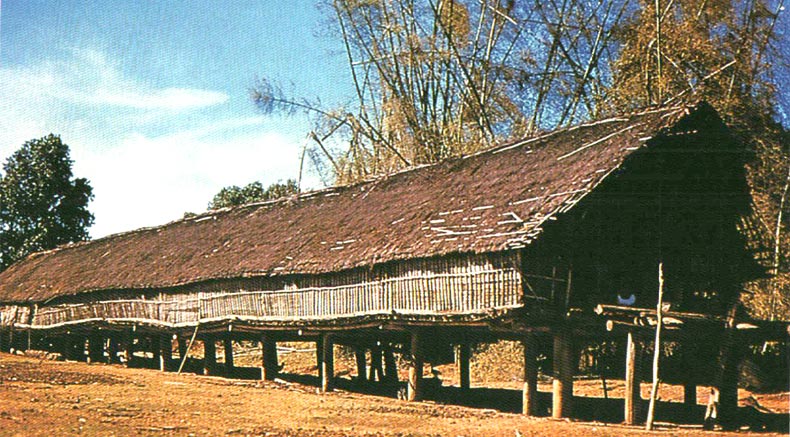
The E DE live in long houses-on-stilts. The richer and larger a family, the longer Its house. Some houses are measured hundreds of meters. The houses are made of wood or bamboo, wltn a thatched roof. In recent years, many houses have divided into smaller constructions and roofed with tiles or steel sheets. An E DE house is featured with the walls leaning outwards, and a upside-down equal trapezoid-shaped roof. The entrance door is located at one end of the house. In the past, the door faced the north and now the road. The interior is divided into two parts. The part with the entrance door, called Gab, is reserved for receiving guests. The rest called Ôk houses the kitchen and different compartments for the couples. Each end of the house has a floor-yard. The yard at the entrance door is called the “guest floor” which is very spaceious if the family is rich.
SEE MORE:
◊ The COMMUNITY of 54 ETHNIC GROUPS in Vietnam – Section 1.
◊ The BA NA Community of 54 Ethnic groups in Vietnam.
◊ The BO Y Community of 54 Ethnic groups in Vietnam.
◊ The BRAU Community of 54 Ethnic groups in Vietnam.
◊ The BRU-VAN KIEU Community of 54 Ethnic groups in Vietnam.
◊ The CHO RO Community of 54 Ethnic groups in Vietnam.
◊ The CO HO Community of 54 Ethnic groups in Vietnam.
◊ The CONG Community of 54 Ethnic groups in Vietnam.
◊ The CHUT Community of 54 Ethnic groups in Vietnam.
◊ The CHU RU Community of 54 Ethnic groups in Vietnam.
◊ The CHAM Community of 54 Ethnic groups in Vietnam.
◊ The DAO Community of 54 Ethnic groups in Vietnam.
◊ The GIAY Community of 54 Ethnic groups in Vietnam.
◊ Vietnamese version (vi-VersiGoo): CONG DONG 54 Dan toc Viet Nam – Phan 1.
◊ Vietnamese version (vi-VersiGoo) with Web-Voice (Web-Audio): Nguoi BA NA trong Cong dong 54 Dan toc anh em o Viet Nam.
◊ Vietnamese version (vi-VersiGoo) with Web-Voice (Web-Audio): Nguoi BO Y trong Cong dong 54 Dan toc anh em o Viet Nam.
◊ Vietnamese version (vi-VersiGoo) with Web-Voice (Web-Audio): Nguoi BRAU trong Cong dong 54 Dan toc anh em o Viet Nam.
◊ Vietnamese version (vi-VersiGoo) with Web-Voice (Web-Audio): Nguoi BRU-VAN KIEU trong Cong dong 54 Dan toc anh em o Viet Nam.
◊ Vietnamese version (vi-VersiGoo) with Web-Voice (Web-Audio): Nguoi CHO RO trong Cong dong 54 Dan toc anh em o Viet Nam.
◊ Vietnamese version (vi-VersiGoo) with Web-Voice (Web-Audio): Nguoi CHAM trong Cong dong 54 Dan toc anh em o Viet Nam.
◊ Vietnamese version (vi-VersiGoo) with Web-Voice (Web-Audio): Nguoi CHU RU trong Cong dong 54 Dan toc anh em o Viet Nam.
◊ Vietnamese version (vi-VersiGoo) with Web-Voice (Web-Audio): Nguoi CHUT trong Cong dong 54 Dan toc anh em o Viet Nam.
◊ Vietnamese version (vi-VersiGoo) with Web-Voice (Web-Audio): Nguoi CONG trong Cong dong 54 Dan toc anh em o Viet Nam.
◊ Vietnamese version (vi-VersiGoo) with Web-Voice (Web-Audio): Nguoi DAO trong Cong dong 54 Dan toc anh em o Viet Nam.
◊ Vietnamese version (vi-VersiGoo) with Web-Voice (Web-Audio): Nguoi GIAY trong Cong dong 54 Dan toc anh em o Viet Nam.
◊ Vietnamese version (vi-VersiGoo) with Web-Voice (Web-Audio): Nguoi GIA RAI trong Cong dong 54 Dan toc anh em o Viet Nam.
◊ etc.
BAN TU THU
07 /2020
NOTES:
1 : … updating…
NOTE:
◊ Source & Images: 54 Ethnic Groups in Vietnam, Thong Tan Publishers, 2008.
◊ All citations and italic textes has been set by Ban Tu Thu – thanhdiavietnamhoc.com