Hanoi – Postcards – FOSSILIZED HERITAGES – Confidential words
Hits: 836
By Prof. Assoc. HUNG NGUYEN MANH1
Hanoi, Ancient Thang Long – an old city, now has gradually become modern. The one thousand – long “cultural” history might have been preserved in museums thanks to the effort of archeological, cultural and historical branches in order to be stored as an cheological vestiges. However, it is clear that owing to preserved post cards, the stature of monuments and streets of over one hundred years of Hanoi, has existed as non-material heritages, according to the way the international cultural organization calls it. They are fossilized images of the past century-cultural heritages of the French colonialists in Vietnam. By that time when the camera came into existence, the remaining images, have expressed deep thoughts about the historical flow of mankind… Since the time of Columbus, the 15th century, it was when the Latin America was discovered, which opened the way to the development of material civilization basing on the rich land abundant in natural resources. The event had inspired explorers, missionaries, and European military expeditionary forces… All went forward to the neglected land of Asia. They paid attention to Vietnam as the springboard to step into China mainland dreaming of building strong and beautiful colonialism in the spirit of civilizing by the use of military force to occupy, rule lots-of areas in the world. All at once, Vietnam together with Hanoi, Saigon in the Indochinese zone had been in the focus of the neo-colonialist style.
In fact, the Vietnamese people had enjoyed the civilized life in the western mode just as the author of “Cultural heritages and after effects of the French colonialists in Vietnam” had mentioned. After lots of blood shedding and tear generations the Vietnamese people had contributed to the historical glory of the struggle for national independence. The Vietnamese people had received what the material culture and civilization from the French had left!
Having heard someone called the name of Hanoi, I have the impression that it is the echo from a very long time ago – thousands of years ago, but in reality that name was officially from the Hue Court (according to a decree dated October 1st, 1888 of Dong Khanh Court) that the sacred piece of land was offered to the French. It was not clear that the French president had based on what certain reason so that a decree was issuedfor the establishment of that name (July 19,1888) in order to take over this old Thang Long and turned it into a lease – hold area (July, 19, 1888). With the civilized standard available together with the ancient – love spirit, the French during the ruling time had kept traditional names of streets but these had been translated into French. However, other names were changed to new names, such as Rue General de Beylite2 to replace the Banana street2, Cobanere2 to replace the Pen street2, Rue Jean Dupuis2to replace the Mat street2.
When the French built western streets and new residential areas, they had inserted names of generals, names of ruling officials, of which a number of books still kept describing their behavior at the time they attacked the northern part of the country of Paul Doumer3, the author of the book and the bridge, the name of which was named after him – the Doumer Bridge. City dwellers of Hanoi from their birth date till their death must have crossed this bridge at least once. Moreover the French also coined a number of words for the transportation system: Carrefour (roundabout), Gare (Railway station), Autorail (electric train). From then on, people in Hanoi as well as in Saigon began to speak French mixed with Vietnamese. Words like tu, toi (you) or “mec xa lit” to reprimand, “met xi (Thank you), pousse pousse (people – drawn cab), marché (market), chemin de fer (railway), Feu (Fire)… By that time an anxious with inmost feeling poet had found rhymes to open the way to the romantic movement with critic realism character. Before the ebbing of the classical literature. This literature had rooted into the Han (old Chinese language) which was then was replaced by the Latin and French. When Latin America had changed before, Indochina had changed day after day right after. The came into life . The “Golden music ”. Why? How had the “Golden music” “smashed” the lonely heart as such! Why had it sewn the true love bud, so romantic and so light-hearted? Why had it also brought such a national love as such? Though tired of the “end of the market at its closing” (the decline of) the outdated way of learning and examining at the Nam Dinh examination center at the wane of old Chinese study, looking at the candidates’ camps-beds and their arched tops that occupied a large piece of land and knowing that the good results of the examination would bring no glory, the anxious poet TRAN TE XUONG had to compose some mocking verses :
A herd of failed candidates stand looking,
He who enjoys passing the exam!
On the chair the French Lady is swaying her buttocks,
On the yard underneath, the bachelors’heads are raising.
The immortal verses composed by the “failed” at the sight of the French mobilizing the ruling machine! However, the Vietnamese king who is sitting imposingly on the golden throne! Did he really understand the sorrow of losing his homeland?
Though called Hanoi so as to remind – it seemed Hanoi had appearedfrom affection for centuries. Nevertheless, it was Thang Long that was “the fossilized memory” of the whole Vietnamese people. At least, Thang Long from the Ly dynasty (XI century) used to be a royal citadel having surrounding walls, with 4 gates looking out to 4 directions: East – West – South – North. Regarding the main structure, Thang Long was distributed by its border into 61 handicraft guilds specialized in productions by different handicrafts and by trading and bartering. But from the XI to the XV century, a lot of handicrafts branches had developed into guilds specialized in “weaving silk and satin“, making porcelain, bronze, jewelry, joss – paper things, “giay do” – rhamnoneuron paper, tissue paper… There were alsotrades that printed folk drawings, making fans, or making rice wine. Up to Thang Long time, 36 guilds had been fixed so as capital city and urban people were named. As early as the early XX century the name was known as Hanoi, the fixed handicraft trades had caught the eyes of the French Oriental study, HENRY OGER, who introduced the new monographic method to use pens to record and to display by the use of engraving planks in order to print, which was called the An Nam people’s Technique (Technique dupeople Anamite)4.
The 36 street–guilds had been formed according to the administrative organization of guild and society or the street in the feudal time, hadn’t it? In fact, according to documents during the occupation of Hanoi, the period from February 2nd, 1947 to September 1954, the French had divided the interior citadel into 36 street-guilds. From then on, the image of Hanoi began to change to western city style. Though experiencing through lots of historical changes, the image and life of Thang Long nowadays have become fossilized in the soul and conscience of the Vietnamese people. However, the form of the half colonialist and half feudal society, as a lot of writers in Hanoi called it, couldn’t blur the image of a meal where people sitting together around the same tray, or the activities at a ferry in Hanoi.
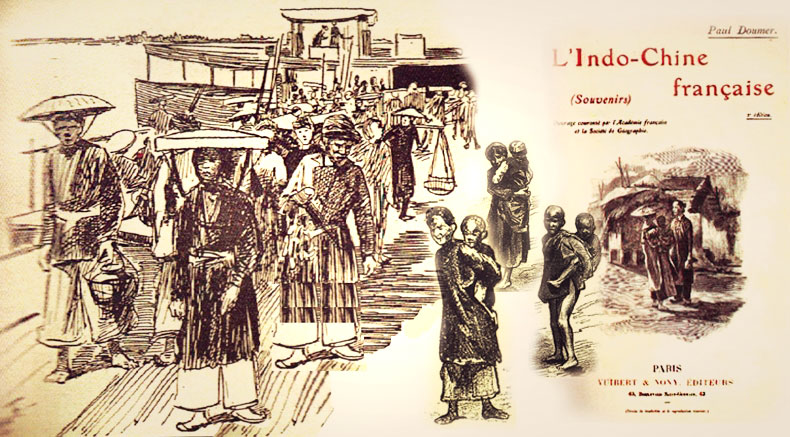
When studying the behaviors and gestures of peoples, the different fossilized ways of people’s carrying children of mothers or sisters which existedfor a time that we would like to have chosen as seen below.
Today, with the permission of the magazine Xua & Nay (Old – Modern Magazine), we would like to present the images that had been used as souvenirs from the collection the French had used cameras to record. Not only the people of Hanoi enjoy seeing them but also the whole Vietnamese people and other peoples can consider them as a memorable stamp of the colonizing process the French had carried out on tkis remote area of the Far East.
◊ Hanoi – POSTCARDS, Fossil Legacies – HANOI, TONKIN – French Indochina – Section 1.
NOTES:
1: NGUYEN MANH HUNG – “Cultural Heritages and Aftereffects of the French Colonialists in Vietnam’’, “History of Vietnam in the Modem Time” – The major course being taught at Hong Bang University International, Osaka University in Japan in the Vietnamese Study Program. Dr. HUNG also had given lectures on these subjects at California State University Fullerton – USA, at Incheon University – Korea, Ecole Orientcle Paris – France and at a number of universities in South East Asia (Thammasat, South Asia University).
2: According to NGUYEN VAN CHUC – Dictionary of streets in Hanoi – Hanoi Publishing House, 2010, pp. 10 —13.
3: PAUL DOUMER – Full name JOSEPH ALHNASE DOUMER (1857-1932) General Governor of Indochina and President of France (1931-1932) was replaced by the Latin and French. When Latin America had changed before, Indochina had changed day after day right after. Then came into life.
4: This is the thesis for the Asssociate Doctor Degree in History of the author NGUYEN MANH HUNG. He had contributed his effort to bring into light what was believed to hide forever in the documentary ware house hidden in the National Library in Hanoi and the Archeology Library (before 1975) in Saigon, which was considered as a treasure to cover the eye from the war. We will publish two separate volumes about the Technique of the An Nam. (Technique of the Anamite people) by early this spring).
BAN TU THU
08 /2020
NOTES:
◊ Source: HANOI, POSTCARDS – Fossilized Heritages, Prof. Assoc. Dr. en History HUNG NGUYEN MANH & Collector, Master TRUC SON NGUYEN PHAN, Hong Duc Publishers, Hanoi, 2015.
◊ All italics textes and images sepiaized was set by BAN TU THU – thanhdiavietnamhoc.com.